
Orijen Tundra has surged in search interest, and it’s easy to see why it attracts attention: it’s a high-protein, biologically-focused kibble built around unusual protein sources. It’s also a useful case study in the trade-offs of premium grain-free food, including the legume question that connects to the broader DCM discussion. Here’s an honest look.
This is an informational review, not veterinary advice. Diet decisions — especially for dogs with health conditions or breed-specific risks — should be made with your veterinarian.
What Orijen Tundra Is
Orijen (made by Champion Petfoods) markets Tundra as a “WholePrey” diet designed to mirror what a dog’s ancestors would have eaten — meat, organs, and bone in ratios meant to reflect natural prey. Tundra specifically is built around less common proteins: its first ingredients are raw lamb, venison, duck, arctic char, and pilchard (a small oily fish).
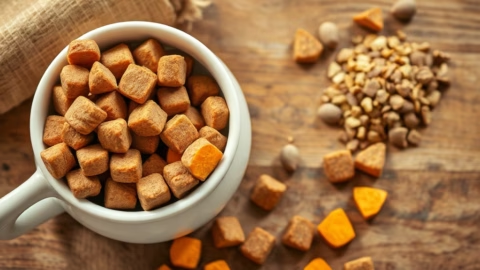
Orijen states the diet contains roughly 85% animal ingredients, coated with freeze-dried liver for palatability. The remaining portion includes whole legumes (lentils, peas, chickpeas, beans) and vegetables like pumpkin and butternut squash. It’s grain-free.
The Strengths
- High animal-protein content. At ~85% animal ingredients and a calorie profile skewed toward protein and fat over carbohydrates (metabolizable energy around 3,860 kcal/kg), it delivers substantially more protein than typical grocery-store kibble.
- Novel and varied proteins. Lamb, venison, duck, and fish are useful for dogs that do better on less common proteins, or for rotating protein sources. This variety is genuinely uncommon at this concentration.
- Whole-prey philosophy. Including organs (like liver) and a range of animal parts provides a broader micronutrient profile than muscle meat alone — conceptually similar to why organ meat matters in raw and fresh diets.
- Ingredient transparency. Orijen is relatively detailed about sourcing and ingredient ratios, which is more than many brands disclose.
The Legume Question (and DCM Context)
Here’s the honest caveat that anyone researching Tundra should understand. The food contains whole legumes — lentils, peas, and chickpeas — as a significant part of its non-meat portion. Legume-heavy grain-free formulas are exactly the category that the FDA investigated in connection with dilated cardiomyopathy (DCM) in dogs.
To be clear about what that does and doesn’t mean: the FDA never established a definitive causal link between any specific ingredient, brand, or formula and DCM, and did not recall grain-free food. But legume-heavy diets were disproportionately represented in reported cases, and the mechanism remains unresolved. We covered this in full in our grain-free and DCM guide, which is worth reading before choosing any legume-forward grain-free food.
This isn’t a reason to single out Orijen Tundra specifically — the same consideration applies to most premium grain-free foods that use legumes as the primary carbohydrate and protein-boosting ingredient. It’s a reason to make the decision with your veterinarian, particularly if you have a breed with known DCM predisposition (Dobermans, Great Danes, Boxers, Cocker Spaniels).
Other Considerations
- Price. Orijen is among the more expensive kibbles on the market — the high animal-ingredient content and sourcing come at a premium per pound.
- Calorie density and carbohydrate. Despite the high-protein marketing, one third-party analysis calculated roughly 18% carbohydrate content — low for kibble, but not zero (no kibble can be, since starch is needed to form the pellet). The high calorie density also means portion control matters; see our portion chart.
- Ingredient residue note. Some third-party reviews flag that legumes, peas, and chickpeas can carry higher pesticide/herbicide residue than some other ingredients — a general point about legume-heavy foods, not unique to Orijen.
- Rich for some dogs. The high protein and fat content is excellent for many active dogs but can be too rich for dogs with sensitive stomachs or certain health conditions — see our sensitive stomach guide if that applies.
Who Is It For?
- Good fit: healthy, active dogs whose owners prioritize high animal-protein content and novel proteins, who can afford the premium price, and who have discussed the grain-free/legume consideration with their vet.
- Think carefully: owners of DCM-predisposed breeds, dogs with sensitive stomachs, or anyone specifically wanting to avoid legume-heavy grain-free formulas until the DCM research is more settled.
Bottom Line
Orijen Tundra is a genuinely high-quality, high-protein kibble with premium sourcing and a novel-protein lineup that stands out in the category. The main caveat isn’t quality — it’s that it’s a legume-forward grain-free formula, which places it squarely in the category worth discussing with your vet given the unresolved DCM questions. If you’ve read the DCM context and it’s the right fit for your dog, it’s a strong product; if legumes are a concern for your specific dog, a grain-inclusive high-protein option may be the more cautious choice.